 IDG TETIS
Creation year
2022
18 record(s)
Provided by
Type of resources
TETIS Keywords
gcmd Keywords
Topics
INSPIRE themes
Years
Scale
Resolution
Contact for the resource
-

Cette carte a été produite dans le cadre du projet FUI-2012 SIRHYUS (Services d'Information pour la gestion des Ressources HYdriques et de leurs USages) et a bénéficié d'une aide de l'Etat gérée par l'Agence Nationale de la Recherche au titre du Programme Investissements d'Avenir pour le projet EQUIPEX GEOSUD ANR-10-EQPX-20.
-

Le territoire régional est composé de taches urbaines de différentes tailles et formes, distribuées de manière variée. Les espaces urbains sont reliés les uns aux autres par le réseau routier, en particulier le réseau composé des routes primaires et secondaires. Cet espace urbain et routier ainsi composé est fortement artificialisé avec une forte composante d’imperméabilisation qui perdure au fil du temps. La dynamique spatiale et temporelle de cet espace peut être évaluée par les surfaces qui deviennent artificialisées, par la consommation des surfaces interstitielles, généralement agricoles ou naturelles. Ces surfaces à faible imperméabilisation, moins artificialisées, sont ainsi des îlots séparés les uns des autres par la trame urbaine et routière. Ces ilots sont de tailles variées et composent une structure fragmentée.Cet indice prend la forme d'une taille effective de maille, à savoir une grandeur qui exprime « la probabilité que deux points choisis au hasard dans un territoire [...] ne soient pas séparés par des obstacles tels que les voies de communication ou des zones bâties » (J. Jaeger, 2007).
-
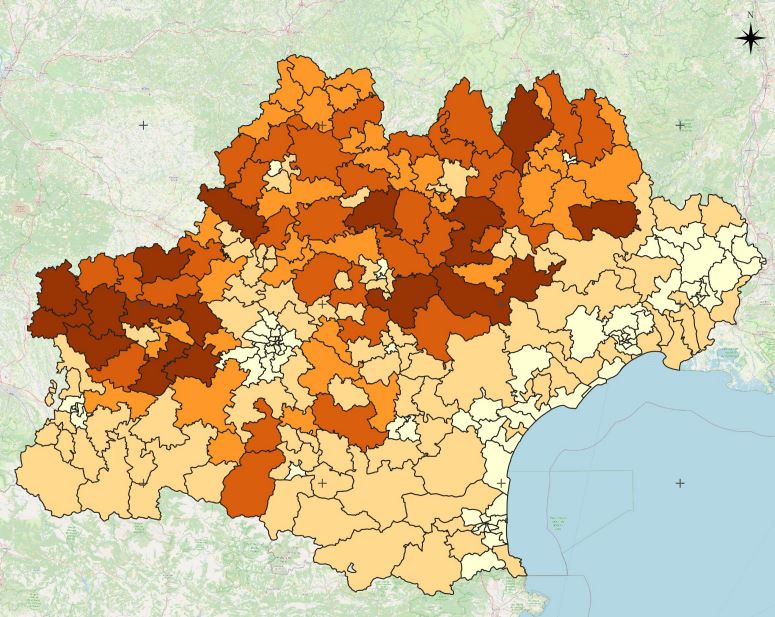
Le coefficient de dispersion représente le rapport entre la surface des espaces artificialisés (taches urbaines) morcelés, définis ici pour une emprise inférieure à 3 hectares, et celle des espaces artificialisés denses supérieurs ou égales à 3 hectares.Cet indicateur a été calculé par canton et pour les années 2015 à 2019.
-

La densité de bâti est calculée par maille de 150 mètres de côté et sur la base d'une extraction du bâti à partir d'imagerie très haute résolution spatiale (1.5m) SPOT 6/7, pour les années 2015 à 2019.
-
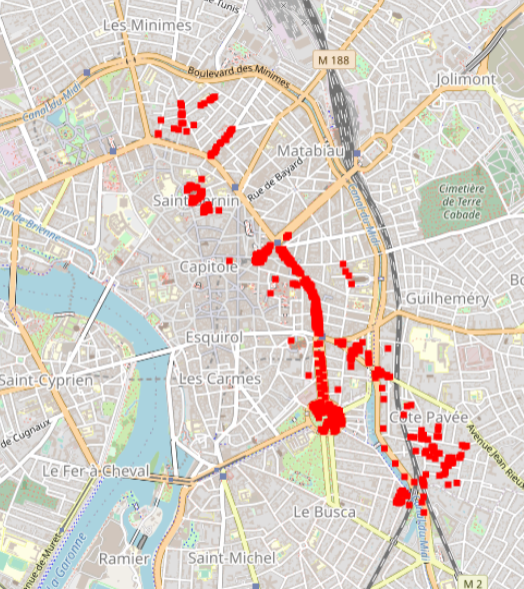
Hyperspectral data were obtained during an acquisition campaign led on Toulouse (France) urban area on July 2015 using Hyspex instrument which provides 408 spectral bands spread over 0.4 – 2.5 μ. Flight altitude lead to 2 m spatial resolution images. Supervised SVN classification results for 600 urban trees according to a 3 level nomenclature: leaf type (5 classes), family (12 and 19 classes) and species (14 and 27 classes). The number of classes differ for the two latter as they depend on the minimum number of individuals considered (4 and 10 individuals per class respectively). Trees positions have been acquired using differential GPS and are given with centimetric to decimetric precision. A randomly selected subset of these trees has been used to train machine SVM and Random Forest classification algorithms. Those algorithms were applied to hyperspectral images using a number of classes for family (12 and 19 classes) and species (14 and 27 classes) levels defined according to the minimum number of individuals considered during training/validation process (4 and 10 individuals per class, respectively). Global classification precision for several training subsets is given by Brabant et al, 2019 (https://www.mdpi.com/470202) in terms of averaged overall accuracy (AOA) and averaged kappa index of agreement (AKIA).
-
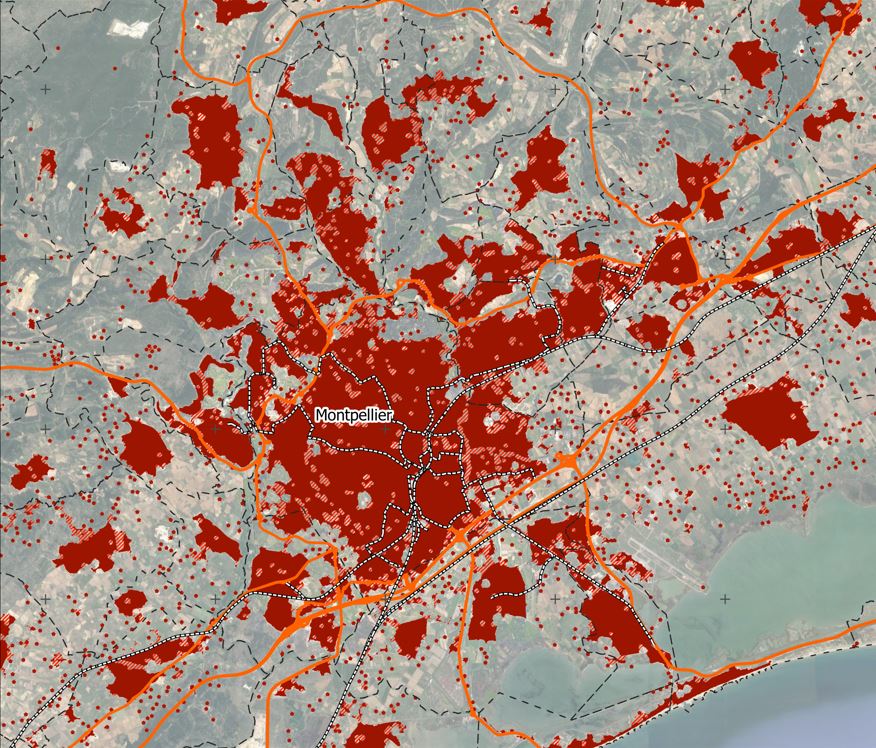
Les taches artificialisées sont calculées sur la base d'une extraction du bâti à partir d'imagerie très haute résolution spatiale (1.5m) SPOT 6/7, pour les années 2015 à 2019. Deux distances de connexion sont proposées, à 50m et 100m.
-

This dataset provides georeferenced polygon vectors of individual tree canopy geometries for dryland areas in West African Sahara and Sahel that were derived using deep learning applied to 50 cm resolution satellite imagery. More than 1.8 billion non-forest trees (i.e., woody plants with a crown size over 3 m2) over about 1.3 million km2 were identified from panchromatic and pansharpened normalized difference vegetation index (NVDI) images at 0.5 m spatial resolution using an automatic tree detection framework based on supervised deep-learning techniques. Combined with existing and future fieldwork, these data lay the foundation for a comprehensive database that contains information on all individual trees outside of forests and could provide accurate estimates of woody carbon in arid and semi-arid areas throughout the Earth for the first time.
-
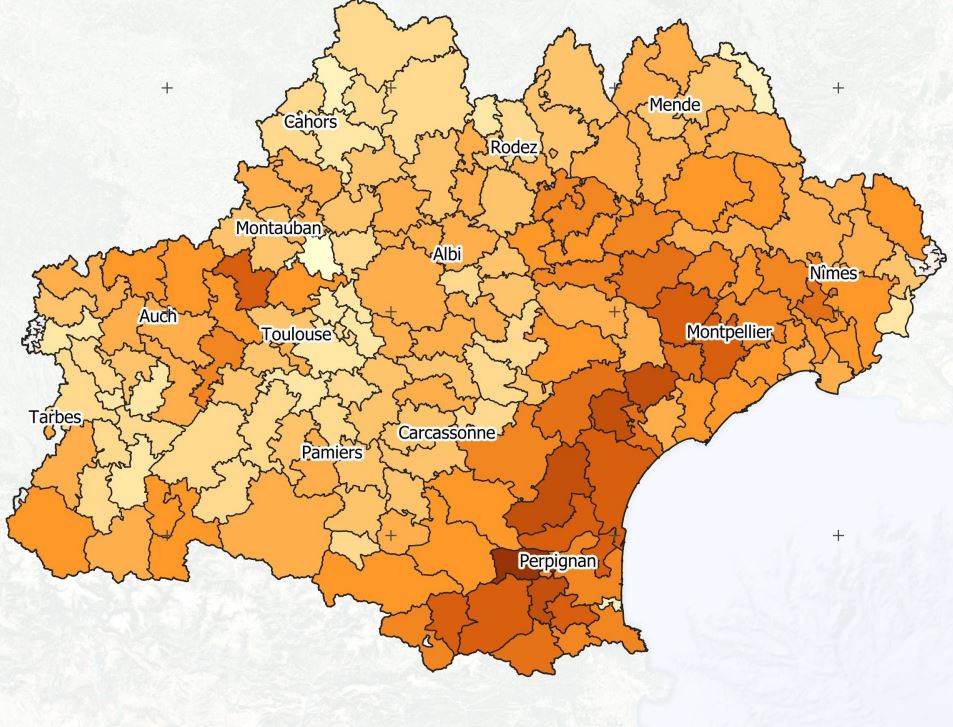
Les taches urbaines distribuées sont caractérisées par des formes très variées. Ces formes peuvent aller d’un aspect très compacte (proche d’un disque, forme de compacité maximale sur un plan) à celui de formes très digitées ou de filaments, s’approchant de lignes plus ou moins sinueuses. Le suivi de cette dimension de compacité morphologique permet d’estimer si l’artificialisation due aux taches urbaines suit des extensions homogènes ou des extensions hétérogènes. Cet indice est calculé à l'échelle des EPCI d'Occitanie et pour l'année 2019.
-

Cette donnée raster résulte d'une classification par méthode d'apprentissage profond à partir d'imagerie très haute résolution spatiale (1.5m) SPOT 6/7. Des post-traitements ont été effectués afin de mieux caractériser les classes relatives à l'artificialisation.
-
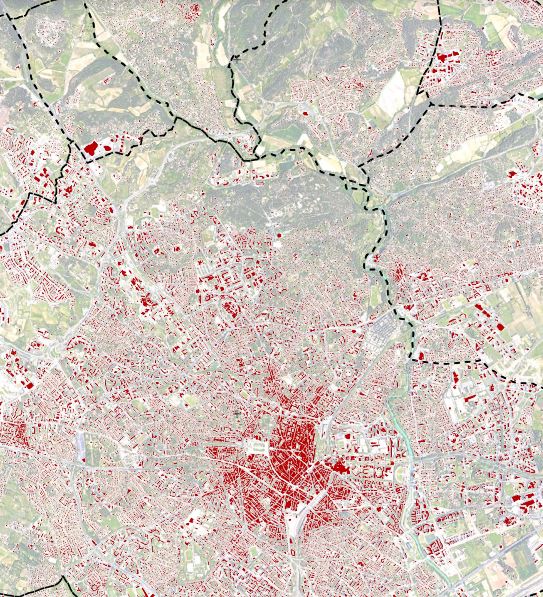
Les cartographies des espaces bâtis sur la région Occitanie résultent d'une extraction automatique par méthode d'apprentissage profond (deep learning) à partir d'imagerie très haute résolution spatiale (1.5m) SPOT 6/7, pour les années 2015 à 2019. Fichiers fournis sous forme vectorielle. (2021-09-09)